On-Page SEO in the UAE: Why the Page Itself Is Where Most Businesses Lose the Game
I was reviewing a website for a Dubai-based interior design firm last summer. Gorgeous portfolio. Stunning photography. The kind of work that makes you stop scrolling. They’d invested in professional copywriting, had a clean site design, and were running a modest link building campaign. By all appearances, they were doing things right. Their homepage ranked on page four of Google for “interior design Dubai.” Page four. Behind firms with worse portfolios, uglier websites, and half the backlinks.
I opened their source code. The title tag on their homepage read “Home | [Company Name].” That’s it. No mention of interior design. No mention of Dubai. The H1 tag was their company logo — an image with no alt text. Their service pages had identical meta descriptions copy-pasted across all twelve of them. The beautiful portfolio images, each one worth showcasing, had file names like IMG_4892.jpg and zero alt attributes. Google had plenty of signals telling it this was a website. It had almost nothing telling it what the website was actually about.
On-page SEO is the practice of making sure every individual page on your site communicates clearly to search engines what it covers, who it’s for, and why it deserves to rank. It’s the most controllable part of SEO — you don’t need to convince a journalist to link to you or wait for Google to recrawl your site. You can fix it today. And in the UAE, where competition for English keywords is fierce and Arabic on-page optimization is nearly nonexistent across most industries, getting this right creates separation that’s hard for competitors to close.
Why On-Page SEO Falls Apart in This Market
The UAE has a specific version of this problem that stems from how websites get built here. Most businesses commission their site from a design-focused agency or a freelance developer. The brief is about aesthetics — brand colors, layout, user flow, visual impact. SEO, if it’s mentioned at all, gets a line item at the bottom: “SEO-friendly.” Nobody defines what that means. The developer interprets it as installing Yoast or RankMath, maybe filling in a few meta titles, and calling it done.
The result is a site that looks professional to visitors but is functionally mute to search engines. Title tags that are either generic or missing. Header hierarchy that’s driven by visual design rather than content structure — a designer who thinks an H2 looks better than an H3 will use it regardless of semantic meaning. Internal links that follow the navigation menu and nothing else, leaving dozens of pages with no contextual links pointing to them. Image optimization treated as an afterthought because “nobody reads alt text.”‘
Then there’s the bilingual problem. For UAE businesses that serve both English and Arabic audiences, on-page optimization needs to happen separately for each language version. Not translated — independently optimized. The Arabic title tag for a page about “villa renovation in Abu Dhabi” shouldn’t be a Google Translate rendition of the English title. It should be crafted around the Arabic keywords that people actually search for, which often have different structure, different modifiers, and different intent signals than their English equivalents. The vast majority of bilingual UAE sites either skip Arabic on-page optimization entirely or run the English version through an automated translator and call it done.
On-Page SEO Is a Conversation With an Algorithm
Here’s a useful way to think about what on-page optimization actually does. When Google crawls a page, it’s trying to answer a question: what is this page about, and how well does it satisfy a searcher’s intent? Your on-page elements are how you answer that question. The title tag is your headline pitch. The meta description is your elevator speech. The H1 is your thesis statement. The subheadings are your outline. The body content is your argument. The internal links are your references. The images and their alt text are your evidence.
If any of those elements are missing, vague, or contradictory, Google’s confidence in your page drops. It doesn’t penalize you in the punitive sense — it just ranks a page that answers the question more clearly. And in the UAE’s competitive verticals — real estate, hospitality, healthcare, legal, education — there’s always a competitor whose page answers the question better. Not because their content is superior, but because their on-page signals are sharper.
This is what makes on-page SEO so frustrating and so powerful at the same time. You can have the best content on the internet about a topic, but if Google can’t parse what that content is about from the structural signals on the page, it won’t rank. Conversely, well-optimized pages with decent (not exceptional) content routinely outrank brilliant content with poor on-page signals. I’ve seen it happen in the UAE market over and over. The firm that wins isn’t always the one with the deepest expertise. It’s the one that communicates its expertise in a language Google understands.
The On-Page Elements That Actually Move Rankings
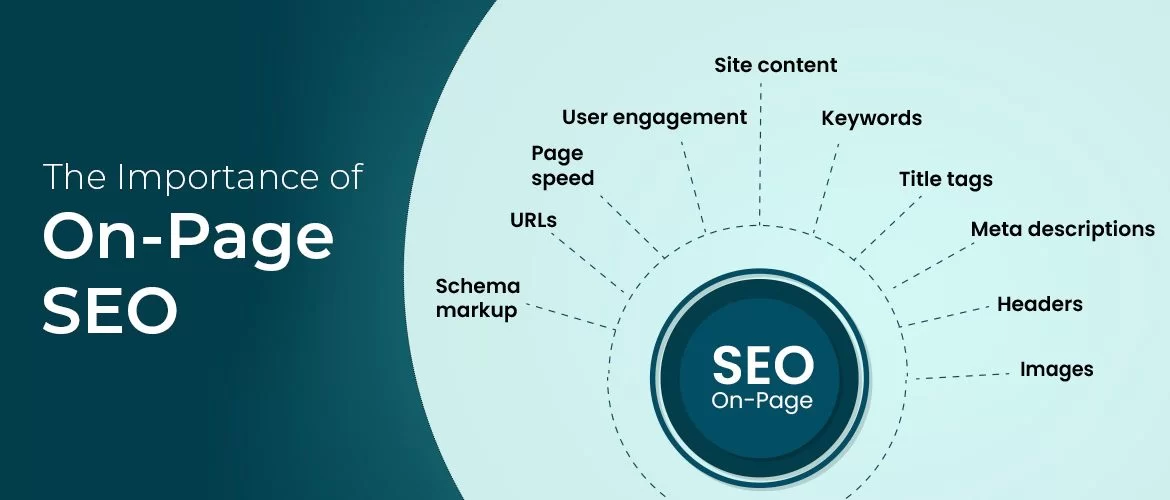
Title tags are still the single most influential on-page element. For UAE businesses, every page that you want to rank for a specific query should have a unique title tag that includes the primary keyword naturally, ideally near the beginning. Keep it under 60 characters so it displays fully in search results. Include a geographic modifier when relevant — “in Dubai,” “UAE,” or the specific emirate. And make it compelling enough that a human would want to click, not just accurate enough for an algorithm to categorize. “Villa Renovation Services in Abu Dhabi | [Brand]” outperforms “Home | [Brand]” by a factor that’s hard to overstate.
Meta descriptions don’t directly affect rankings, but they affect click-through rate, and click-through rate affects rankings indirectly. Write them like ad copy — 150-160 characters that tell the searcher exactly what they’ll find on the page and why it’s worth clicking. Include the primary keyword because Google bolds matching terms in the description. For UAE businesses, including a trust signal works well: years in operation, number of projects completed, specific emirates served. “Trusted by 200+ homeowners across Dubai and Abu Dhabi since 2015” in a meta description performs better than a generic summary of the page.
Header hierarchy — your H1 through H4 tags — needs to follow both logic and keyword strategy. Every page should have exactly one H1 that clearly states the page’s topic and includes the primary keyword. H2s break the content into major sections, each targeting a supporting keyword or subtopic. H3s and H4s provide further structure within sections. This isn’t just for SEO — it’s how Google understands the relationship between ideas on your page. A common mistake on UAE sites: using header tags for visual styling. If your developer chose an H2 for a sidebar widget title because it looked the right size, that’s a signal to Google that the sidebar content is a major section of the page. Semantic HTML matters.
Content depth and structure are where on-page SEO meets content quality. Google evaluates whether a page satisfies search intent comprehensively. For a page targeting “company formation in Dubai,” a 300-word overview loses to a 2,000-word guide that covers free zones, mainland licensing, costs, timelines, required documents, and common mistakes — because the longer piece actually answers the full scope of what someone searching that term wants to know. But length alone isn’t the point. Structure is. Break the content into scannable sections with descriptive subheadings. Answer the specific questions that appear in Google’s “People Also Ask” for your target keyword. Use the vocabulary that naturally clusters around the topic — related terms and entities that Google expects to find on a page about that subject.
Internal linking is the most underused on-page lever in the UAE. Every page on your site should link to other relevant pages using descriptive anchor text — not “click here” or “learn more,” but text that tells Google what the linked page is about. “Our villa renovation process in Abu Dhabi” as anchor text pointing to your Abu Dhabi service page is an on-page signal for both pages. Most UAE websites only link through navigation menus, which means their deep pages — blog posts, secondary service pages, location-specific pages — are isolated islands with no contextual connections. Build links between related pages the way you’d build connections between related ideas in a conversation.
Image optimization is free ranking power that UAE businesses almost universally ignore. Every image should have a descriptive file name (villa-renovation-abu-dhabi-living-room.jpg, not IMG_4892.jpg). Every image should have alt text that describes what the image shows and includes relevant keywords where natural. Images should be compressed and served in modern formats like WebP. For businesses with visual portfolios — interior design, architecture, real estate, hospitality, food — image search is a genuine traffic channel. Google Images drives meaningful visits for visual industries, and the only way your images appear there is through proper optimization.
On-Page Optimization for Arabic Content
This section matters enough to warrant its own treatment. Arabic on-page SEO is not English on-page SEO translated. The differences run deeper than language.
Arabic keyword placement in title tags and headers follows different patterns. Arabic is a right-to-left language, and while Google doesn’t read title tags directionally, the natural phrasing of Arabic search queries puts modifiers and qualifiers in different positions than English does. “تصميم داخلي في دبي” (interior design in Dubai) has a different word order emphasis than its English equivalent, and the title tag should reflect the Arabic phrasing, not mirror the English structure.
Arabic meta descriptions need cultural calibration, not just translation. The persuasive triggers that work in English ad copy don’t always translate culturally. In Arabic, trust signals often carry more weight — years of experience, professional certifications, client references. Direct calls to action that feel natural in English (“Get your free quote today”) can feel abrupt in Arabic, where a warmer, relationship-oriented tone converts better.
Arabic content depth expectations differ by topic. For some verticals — particularly legal, financial, and governmental topics — Arabic-speaking users in the UAE expect thorough, formal content. Thin Arabic pages that read like translated summaries of the English version get bounced quickly. If you’re going to publish Arabic content, invest in making it genuinely useful for an Arabic-speaking audience, not a perfunctory translation that exists solely for SEO purposes. Google’s algorithms are increasingly good at identifying thin translated content and deprioritizing it.
Schema markup should be implemented in Arabic for Arabic pages. Most businesses that bother with structured data only implement it in English, even on their Arabic pages. Google supports Arabic schema, and providing it tells the algorithm that your Arabic content is a first-class citizen, not an afterthought. LocalBusiness schema with Arabic business name and description, FAQ schema with Arabic questions and answers, Service schema with Arabic service names — these are small implementations with outsized impact because almost nobody in the UAE does them.
The Five On-Page Mistakes I See Most Often on UAE Sites
Duplicate title tags across multiple pages. This is the most common issue by a wide margin. Service pages, location pages, and blog posts all sharing the same title tag — or having title tags auto-generated by the CMS that include only the site name. Run a Screaming Frog crawl and export the title tag report. If more than 10% of your pages share a title tag with another page, you have a problem.
Keyword cannibalization — multiple pages targeting the same keyword. A Dubai law firm with separate pages for “business setup in Dubai,” “company registration in Dubai,” and “starting a business in Dubai” is competing against itself. Google has to choose which page to rank, and often chooses none of them because the signals are split. Audit your keyword map and make sure each target keyword has one definitive page.
Thin content on service and location pages. A page that says “We provide interior design services in Abu Dhabi. Contact us for a consultation.” is not a page that Google will rank. It provides no value to the searcher and no signals to the algorithm beyond the bare keyword mention. Every page you want to rank needs enough depth to actually satisfy the intent behind the search query it targets.
Missing or broken internal links. Pages that can only be reached through the navigation menu or sitemap, with no contextual links from related content, are underperforming. Especially blog posts — most UAE business blogs publish articles that never link to service pages, and service pages that never link to supporting blog content. These are missed signals that cost nothing to fix.
Ignoring search intent entirely. This is subtler but just as damaging. A page targeting “cost of living in Dubai” that’s actually a promotional page for relocation services doesn’t match the informational intent behind that query. Google knows the difference. The pages that rank for informational queries provide information. The pages that rank for commercial queries provide comparison and evaluation. Matching your page’s content and format to the intent behind the keyword is on-page optimization at its most fundamental.
A Page-Level Optimization Checklist
For every page you want to rank, run through this sequence. Identify the single primary keyword the page targets — one page, one primary keyword. Write a unique title tag under 60 characters that includes the keyword and a geographic modifier if relevant. Write a unique meta description under 160 characters that includes the keyword and a reason to click. Set the H1 to a natural variation of the title tag. Structure the content with H2 and H3 subheadings that incorporate supporting keywords. Add two to five internal links to and from related pages using descriptive anchor text. Optimize every image with descriptive file names and alt text. Add relevant schema markup. For bilingual sites, repeat this entire process independently for the Arabic version — do not copy and translate.
This process takes fifteen to thirty minutes per page. For a site with fifty important pages, that’s roughly two to three days of focused work. The return on that investment, in a market where most competitors haven’t done even half of this, is disproportionately large.
The Design Firm That Stopped Being Invisible
That interior design firm from the opening. We didn’t change their content. We didn’t build a single new link. We rewrote every title tag and meta description. Restructured the header hierarchy across the site. Added alt text to 180 portfolio images with descriptive, keyword-rich file names. Built internal links between their project pages, service pages, and blog content. Implemented LocalBusiness and Service schema. Total time: about four days of work.
Within eight weeks, their homepage moved from page four to the middle of page one for “interior design Dubai.” Three service pages entered the top ten for their target keywords. Their portfolio images started appearing in Google Image results, driving a traffic source they’d never had before. And the phone started ringing in a way it hadn’t since the site launched.
On-page SEO doesn’t make headlines. There’s nothing flashy about rewriting a title tag or adding alt text to an image. But in the UAE, where so many businesses have invested in beautiful websites that Google can barely interpret, these small, precise adjustments are often the difference between being found and being forgotten. The pages are already there. The content already exists. The only thing missing is the clarity that tells Google — and your future customers — exactly what you have to offer. That clarity is yours to create, today, without spending another dirham on content or links. Few things in marketing are that straightforward. Fewer still deliver this reliably.